Why Your Home Security Camera Is Not Enough to Stop Intruders
We all know the familiar feeling of unboxing a brand new smart security camera. You mount it above your garage or next to your front door, connect it to your Wi-Fi, and suddenly you feel a wave of relief. You can check your property from your smartphone anywhere in the world. You feel protected.
But a few weeks later, a package disappears from your porch. You open your app to review the footage, and there it is: a crystal-clear, high-definition video of a stranger wearing a dark hoodie and a medical mask walking up, grabbing your box, and walking away. The police take a report, but the video rarely leads to a recovered item.
This is the harsh reality that many homeowners face. Security cameras are incredible tools for documentation, but on their own, they are entirely passive. They do not physically stop a burglar from breaking a window, and they do not stop a porch pirate from taking your deliveries.
If you want to truly protect your family and your property, you need to transition from passive observation to active deterrence. Here is the comprehensive guide to building a security system that actually scares intruders away before they ever step foot on your grass.
Understanding the Difference Between Passive Observation and Active Defense
To outsmart a criminal, you have to think like one. Studies show that the vast majority of burglaries are crimes of opportunity. Intruders are looking for houses that are dark, quiet, and unoccupied. They want to get in and get out without being seen or heard.
A passive system simply watches the house. A standard camera setup falls into this category. The intruder knows that even if the camera sees them, it cannot physically intervene. Because of modern disguises, the fear of being recorded has drastically decreased over the last few years.
An active defense system fights back. It creates an environment that is highly uncomfortable and unpredictable for an intruder. By combining your cameras with automated lighting, smart locks, and audio deterrents, you create an illusion of presence. If you are struggling with local theft, you should read our deep dive on why you must build an active defense system to stop porch pirates in Kansas City.
How Smart Lighting Acts as Your First Line of Defense
Light is the number one enemy of a burglar. However, leaving your porch light on 24 hours a day is not the solution. In fact, a porch light that is left burning all day and all night is a classic signal to criminals that you are out of town on vacation.
The secret is intelligent, responsive lighting. By installing smart switches or smart bulbs throughout the exterior and interior of your home, you can control the environment dynamically.
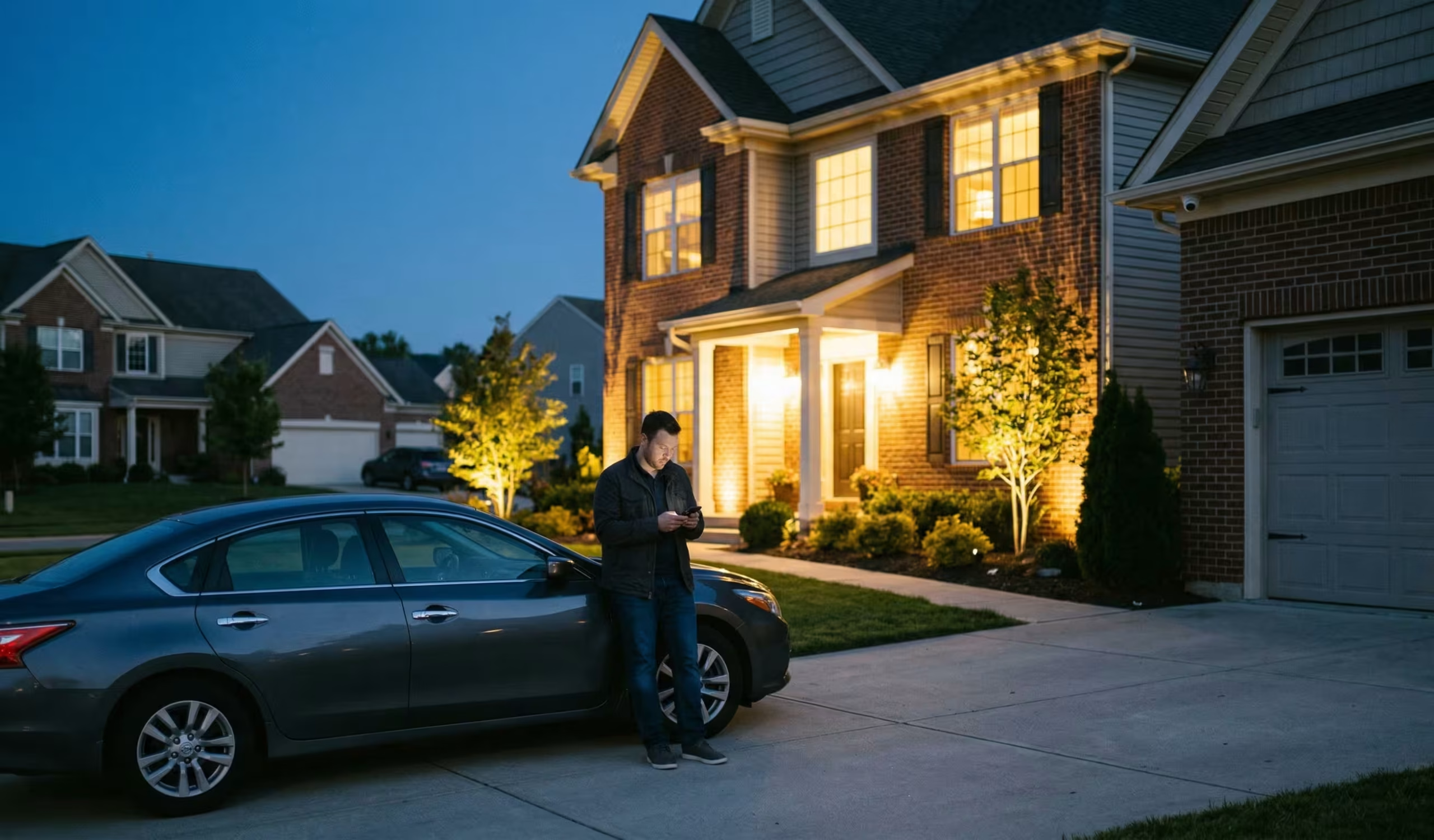
Imagine an intruder walking up your dark driveway at two in the morning. If your house has standard motion lights, they might just click on brightly. The intruder freezes, waits a few seconds, realizes no one is coming out, and continues walking.
Now imagine that same intruder walking up a driveway equipped with a smart ecosystem. As they cross the property line, the landscape lights brighten by fifty percent. As they get closer to the house, the porch light turns on. And most importantly, as they step onto the porch, a smart switch inside the house automatically turns on the hallway light and the living room lamp.
To the intruder, this does not look like an automated timer. It looks exactly like the homeowner just woke up, turned on the hall light, and is walking toward the front door. The intruder will almost always turn around and run.
Mastering the Concept of Mockupancy to Trick Intruders
This illusion of presence has a technical term in the smart home industry. We call it “Mockupancy,” which is a combination of the words “mock” and “occupancy.”
Old school mechanical timers are predictable. They turn the living room lamp on at 7:00 PM and turn it off at 11:00 PM every single day. Anyone watching your house for a couple of days will instantly recognize the pattern and know that the house is actually empty.
Modern Mockupancy algorithms are infinitely smarter. When you put your smart home system into “Vacation Mode,” the system begins to randomly turn lights, televisions, and radios on and off in a way that mimics real human behavior. It might turn the kitchen lights on at 6:15 PM one day, and 6:42 PM the next. It might turn on the bathroom light for five minutes in the middle of the night.
This randomization makes it virtually impossible for an outside observer to tell if the house is vacant or occupied. They will simply move on to an easier target.
Connecting Your Cameras to Your Lighting Ecosystem Seamlessly
The true magic of a modern smart home happens when different devices talk to each other. Your cameras should act as the “eyes” of your house, and your lights should act as the “muscles.”
If you have invested in the Ring ecosystem, for example, you can create powerful automations using platforms like Amazon Alexa. You can set a rule that says if the backyard camera detects a person after midnight, all of the exterior floodlights should turn on at maximum brightness, and your indoor smart speakers should play the sound of a dog barking.
Setting this up requires a bit of software configuration, but the results are incredibly effective. We have a complete guide specifically focused on integrating Ring cameras with Alexa routines for seamless home automation that walks you through this exact process step by step.
It is important to note that a camera is only as good as its placement. A poorly placed camera that misses the primary walkways will never trigger your lighting automations in time. Avoid the top Ring installation mistakes that weaken your security by ensuring your cameras have a clear, unobstructed field of view.
Why a Robust Network Is the Backbone of Smart Security
There is a hidden vulnerability in almost all DIY security systems. Because cameras, smart locks, and smart switches rely on your home internet connection to communicate, your security is only as strong as your Wi-Fi.
If your router is located in the basement and struggles to send a signal to the camera mounted on your garage, that camera might experience a delay. If an intruder walks up, but the camera takes ten seconds to reconnect to the Wi-Fi before telling the porch light to turn on, the intruder is already at your door.
For a true active defense system, you need an enterprise-grade network with hardwired access points. Devices related to life safety and security should never be struggling for a signal. If you are deciding between battery-powered Wi-Fi cameras and hardwired Power over Ethernet (PoE) systems, it is crucial to understand the reliability differences. You can read our comparison on choosing between a Ring doorbell and a dedicated network camera system to make the best choice for your property.
Taking the Next Steps to Secure Your Property Properly
A single camera on a wall is a great starting point, but it should never be your finish line. By integrating intelligent lighting, creating randomized occupancy routines, and ensuring your home network is bulletproof, you transform your home into a fortress.
Technology should work for you automatically, giving you peace of mind whether you are sleeping upstairs or vacationing across the country. Do not wait for a package to go missing to realize your passive system needs an upgrade.