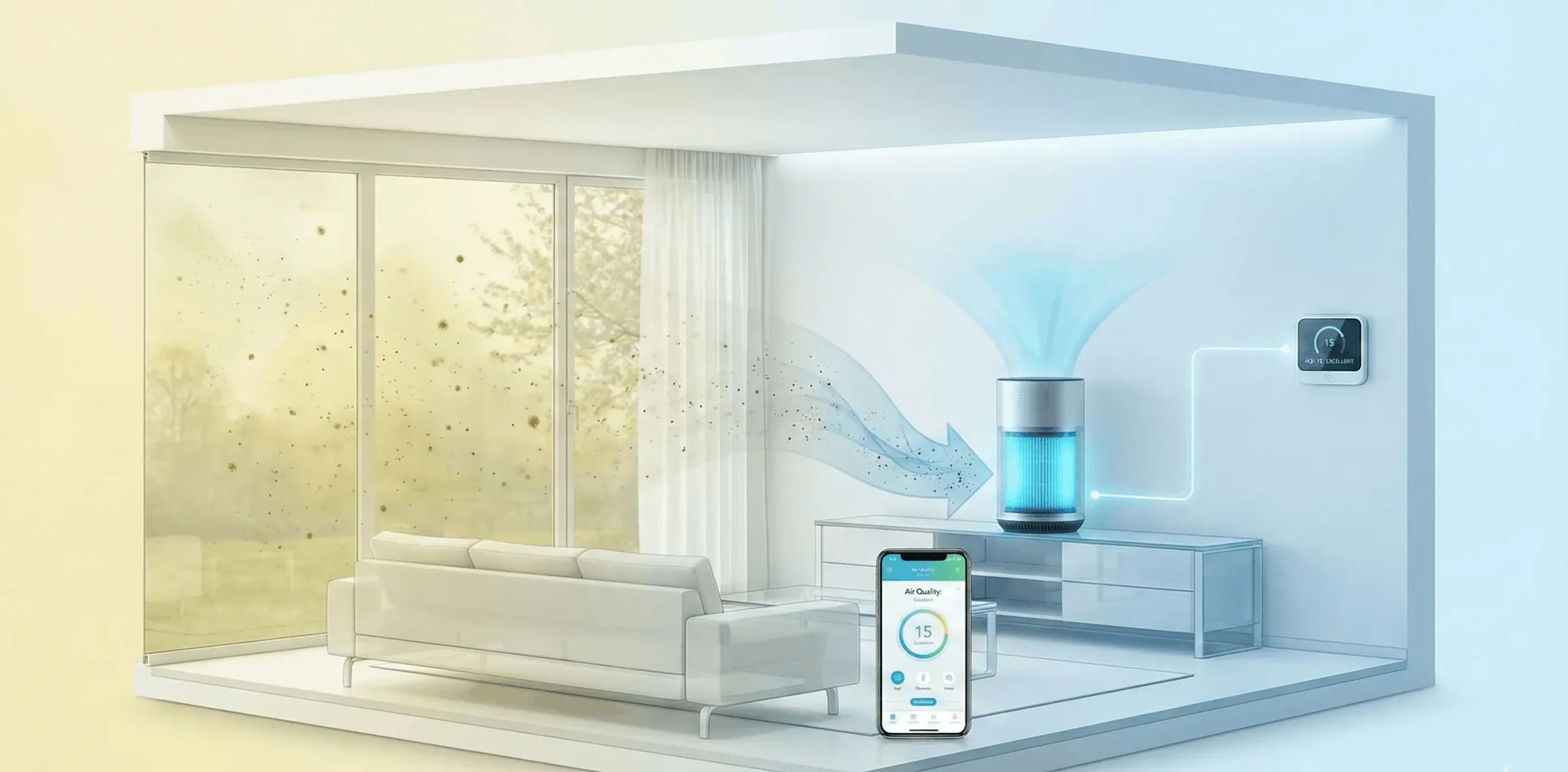
Using Smart Home Technology to Survive Spring in the Nation’s Allergy Capitals
For residents of the Midwest, the arrival of spring is a double-edged sword. While the blooming redbuds and oaks are visually stunning, they signal the beginning of a respiratory siege. If you live in Kansas City or Wichita, you are living in ground zero for seasonal allergies.
The Asthma and Allergy Foundation of America (AAFA) consistently ranks our region among the top “Allergy Capitals” in the United States. This is not a coincidence; it is a geographical reality. We sit in a convergence zone where wind-pollinated species like Oak and Walnut saturate the air in spring, followed by aggressive Ragweed in the fall. Furthermore, our humid river valleys create a perfect breeding ground for Mold spores year-round.
For decades, the only defense was medication—antihistamines that leave you drowsy or nasal sprays that dry you out. But as a Healthy Home Consultant, I advocate for a different approach. We can treat the home as a biological clean room.
By deploying an ecosystem of laser-based sensors, automated HVAC protocols, and HEPA filtration, we can physically remove these irritants from the air you breathe. This is not just about comfort; it is a health necessity.
You Cannot Manage Invisible Allergens Without Laser-Based Monitoring
The first step in securing your air quality is quantification. Most homeowners have no idea what they are breathing because pollen and mold spores are microscopic. We specifically track PM2.5—particulate matter with a diameter of fewer than 2.5 micrometers.
These particles are small enough to bypass your nose’s natural defenses and penetrate deep into the lungs, and in some cases, enter the bloodstream. To detect them, we cannot rely on guesswork. We use Laser Scattering Technology.
Devices like the Airthings View Plus or Awair Element contain internal chambers where a laser beam is projected. As air flows through the device, particles disrupt the beam. The sensor measures the light scattering to calculate the concentration of allergens in real-time.
When you install these monitors in key areas (bedrooms and living rooms), you stop guessing why you woke up congested. You get a data stream that tells you exactly when the Oak pollen count spiked inside your home, allowing you to take immediate action.
Your HVAC System Can Be Automated to Act as a Whole-Home Air Scrubber
Once we have data, we need a mechanism to clean the air. Your home’s central heating and cooling system is the most powerful air mover you own, but standard thermostats are designed to control temperature, not quality.
In a standard setup, the fan only runs when the AC or Heater is active. On a mild spring day (70°F), your system sits idle. Meanwhile, pollen is drifting in through door gaps and windows, settling on your furniture because the air is stagnant.
We solve this by integrating your Air Quality Monitor with a Smart Thermostat (like an Ecobee Premium or Google Nest). We create a logic rule based on the real-time readings from your sensors.
The Automation Logic:
IF the Air Quality Index (AQI) rises above 50 (Moderate),
THEN command the HVAC Thermostat to run the Fan for 15 minutes per hour (minimum).
This automation forces the stagnant, pollen-filled air through your central filtration system even if the house doesn’t need cooling. It actively scrubs the air volume of the house until the sensors confirm that the particle count has dropped to safe levels.
High-Efficiency Filtration Is Critical for Trapping Microscopic Particles
Running the fan only works if your filter can actually catch the enemy. This brings us to the MERV (Minimum Efficiency Reporting Values) rating of your furnace filter.
Most homes use cheap fiberglass filters (MERV 1-4) designed only to protect the furnace motor from cat hair. They do absolutely nothing to stop ragweed or mold spores. To impact human health, you must upgrade to a higher standard.
| MERV Rating | Particles Captured | Effectiveness Against Allergens |
|---|---|---|
| MERV 1-4 | > 10.0 microns | Ineffective (Dust bunnies only) |
| MERV 8 | 3.0 – 10.0 microns | Minimal (Catches some mold/pollen) |
| MERV 13 | 0.3 – 1.0 microns | The Gold Standard (Bacteria, Smoke, Fine Pollen) |
We recommend a MERV 13 filter (like the Filtrete 1900 or 2200). However, be aware that these filters restrict airflow. Your HVAC system needs to be assessed to ensure the blower motor can handle the increased static pressure without failing.
Smart Plugs Transform Dumb Purifiers into Reactive Health Devices
Sometimes, the central system isn’t enough, especially in bedrooms where you spend eight hours a night. Standalone HEPA purifiers are excellent, but manually turning them on and off is inefficient.
We integrate standalone units (like Coway or Honeywell) using Smart Plugs. Most purifiers have a physical switch. By leaving the switch “On” and controlling the power via a smart plug, we can link the purifier to your central Airthings data.
If the PM2.5 levels spike in the master bedroom—perhaps because a window was briefly opened—the system detects the breach. The smart plug activates the HEPA purifier instantly. It runs at high speed until the laser sensor confirms the air is clean, and then shuts off to save energy and filter life. This is reactive, precision wellness.
Technology Is Your Best Defense Against Kansas City Air
Living in an allergy capital does not mean you are destined to suffer. The pollen count outside might be 11.0 (High), but the air inside your home can remain pristine.
By moving beyond passive measures and adopting an active, sensor-driven defense system, you reduce the systemic inflammation caused by breathing dirty air. You sleep better, you think clearer, and you rely less on medication.