Building the Ultimate Chiefs Kingdom Backyard Watch Party Requires Specialized Technology
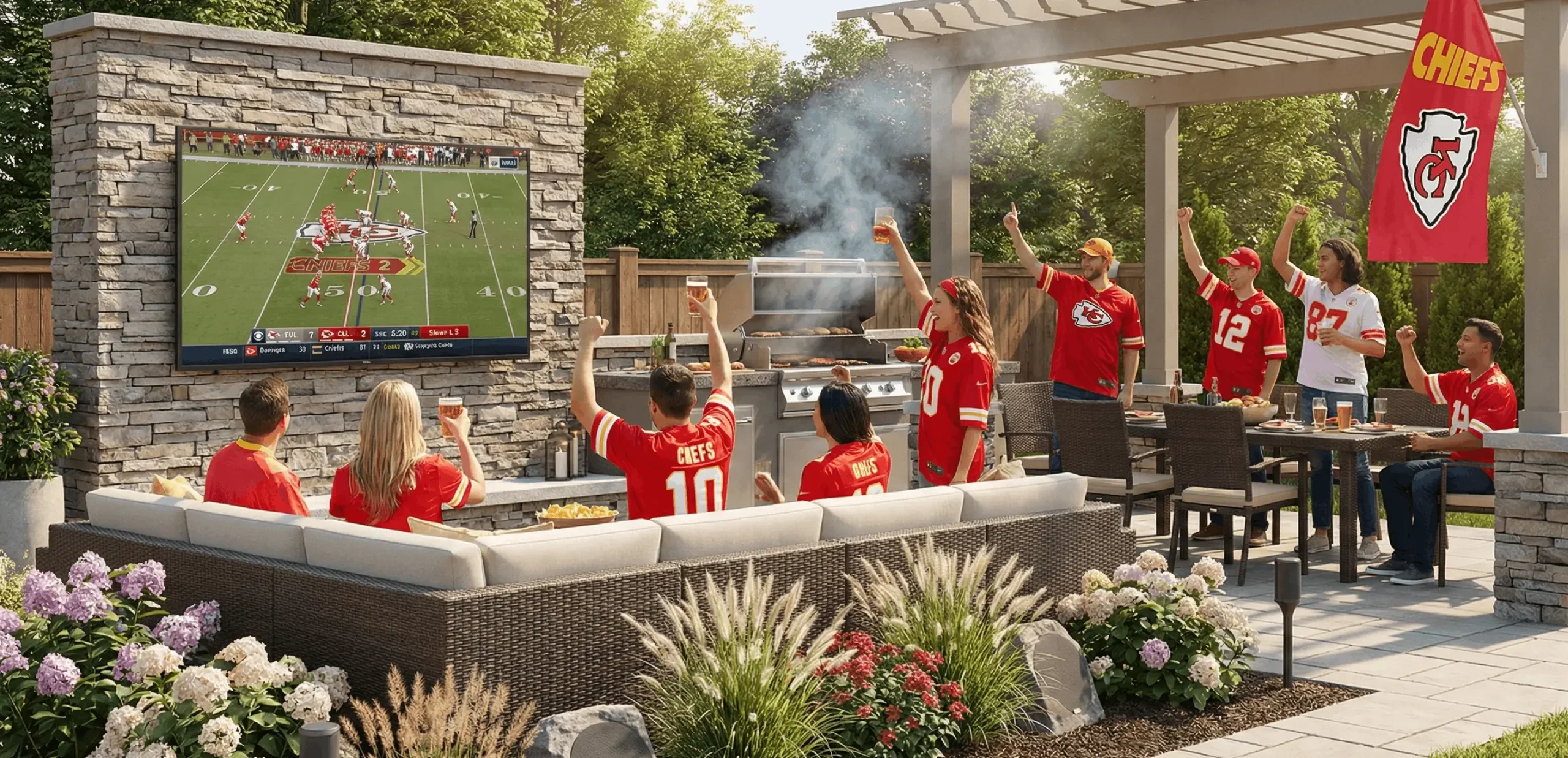
It is Sunday in Kansas City. The air smells like burnt ends and charcoal. You are wearing your lucky red jersey. Patrick Mahomes is about to lead the offense onto the field at Arrowhead. You have the grill fired up on the patio, the cooler is stocked, and your friends are arriving.
But then, the tragedy happens. Everyone has to go inside to watch the kickoff.
Why? Because you don’t have a TV outside. Or worse, you tried to drag your spare bedroom TV onto the deck, and nobody can see the screen through the glare. You are forced to choose between the beautiful autumn weather and the game.
It doesn’t have to be this way. You can turn your backyard into the best sports bar in the neighborhood. But you cannot do it by cutting corners. The environment in Missouri and Kansas is hostile to electronics.
Here is how we build a dedicated outdoor entertainment zone that survives our weather and delivers a picture bright enough to rival the Jumbotron.
Bringing Your Indoor Television Outside Is a Fire Hazard and a Viewing Failure
Every season, I see the same mistake. A homeowner buys a standard $400 LED TV from a big-box store and mounts it under their covered patio. They think, “It’s under the roof, so it won’t get rained on. It’ll be fine.”
This is a dangerous misconception. Even if direct rain never hits the screen, humidity will kill it. Indoor TVs are vented to allow heat to escape. In a humid KC summer, moisture enters those vents and condenses on the circuit boards. This leads to corrosion, short circuits, and in rare cases, electrical fires.
Furthermore, standard TVs are not built to handle temperature swings. When we hit freezing temperatures in January (playoff season), the liquid crystals in a standard LCD panel can actually freeze and crack. Using an indoor TV outside effectively voids your warranty and puts your home at risk.
You Need 2,000 Nits of Brightness to Outshine the Kansas Sun
Even if the indoor TV survives the moisture, the picture will be unwatchable. This comes down to a metric called Nits.
A “Nit” is a unit of measurement for brightness (candela per square meter).
- Standard Indoor TV: Outputs roughly 300 to 500 Nits. This is perfect for a dim living room.
- Outdoor Daylight: The sun is capable of overwhelming screens with thousands of Nits of ambient light.
When you take a 300-Nit screen outside, the sun washes out the image. The blacks turn grey, the colors disappear, and you end up staring at your own reflection in the glass. You won’t be able to tell if it was a touchdown or an interception.
The Solution: dedicated Outdoor TVs.
Devices like the Samsung The Terrace or the SunBrite Pro Series are engineered specifically for this battle. These units pump out 1,500 to 2,500 Nits of brightness. They also feature specialized anti-glare coatings.
With a high-nit outdoor display, you can watch the noon game in direct sunlight, and the picture will punch through the glare with vivid, saturated Red and Gold colors.
IP Ratings Ensure Your Gear Survives Kansas City Winters and Humid Summers
Since we live in the Midwest, your gear needs to be built like a tank. We look for the Ingress Protection (IP) Rating.
An outdoor TV is not just a bright screen; it is a sealed vault. It is built with gaskets, hydrophobic coatings, and internal heating and cooling systems. A proper outdoor unit carries a rating of IP55 or higher.
- First Digit (Solids): Rated 5. Protected against dust ingress (pollen, dirt from the garden).
- Second Digit (Liquids): Rated 5. Protected against low-pressure water jets from any direction.
This means you can hit the TV with a garden hose to clean off the dust, and it will be fine. More importantly, it means the TV can sit on your patio in February when it is 10 degrees below zero, waiting for the AFC Championship game, without the internal components shattering.
A 70-Volt Landscape System Delivers Stadium Sound Without Annoying the Neighbors
Once you have the picture, you need the roar of the crowd. This is where most DIY setups fail. People usually mount two large speakers on the back wall of the house and crank the volume up.
The Physics Problem:
To hear the commentary at the pool or the fire pit (30 feet away), you have to blast the volume at the source (the house). This makes it deafeningly loud for people sitting on the deck and annoying for your neighbors next door. Sound follows the inverse square law—it drops off quickly over distance.
The Solution: 70-Volt Landscape Audio.
Instead of two loud speakers, we install eight to ten small “satellite” speakers and a buried subwoofer around the perimeter of your yard. These systems (from brands like Sonance or Coastal Source) run on high-voltage daisy chains.
We hide these satellite speakers in your flower beds and mulch, aiming them inwards toward the listening area.
- Uniform Coverage: You create a blanket of sound. You can hear the play-by-play clearly at low volume, no matter where you stand.
- Neighbor Friendly: Because the speakers are facing your house (not your neighbor’s fence), the sound stays contained in your “zone.”
You get the thumping bass of the stadium experience without the police showing up for a noise complaint.
This Is How You Win the Weekend
You invest in your grill. You invest in your patio furniture. Do not let the experience fall apart at the finish line with bad technology.
A true outdoor entertainment system allows you to host the ultimate watch party. You get the 4K brightness to see every play, the durability to withstand a thunderstorm, and the immersive audio to feel the energy of the crowd.
Are you ready to turn your backyard into the ultimate fan zone?
At SmartHome Connect, we know how to battle the Kansas City elements. Let us design a weatherproof audio-video system that will last season after season.