A Pull-Down Mount Will Save Your Neck and Solve the TV-Over-Fireplace Dilemma in Classic KC Homes
If you own a Shirtwaist in Brookside, a Tudor in Armani Hills, or a Colonial in Hyde Park, you face a dilemma that the original architects of the 1920s never anticipated. Your living room was designed around a single focal point: the fireplace. In the pre-television era, the hearth was the heart of the home, flanked by windows or built-in bookshelves.
Today, however, the focal point of the modern living room is the television. This creates a design conflict. You cannot block the fireplace, and you cannot block the windows. By process of elimination, the TV ends up mounted directly above the mantel.
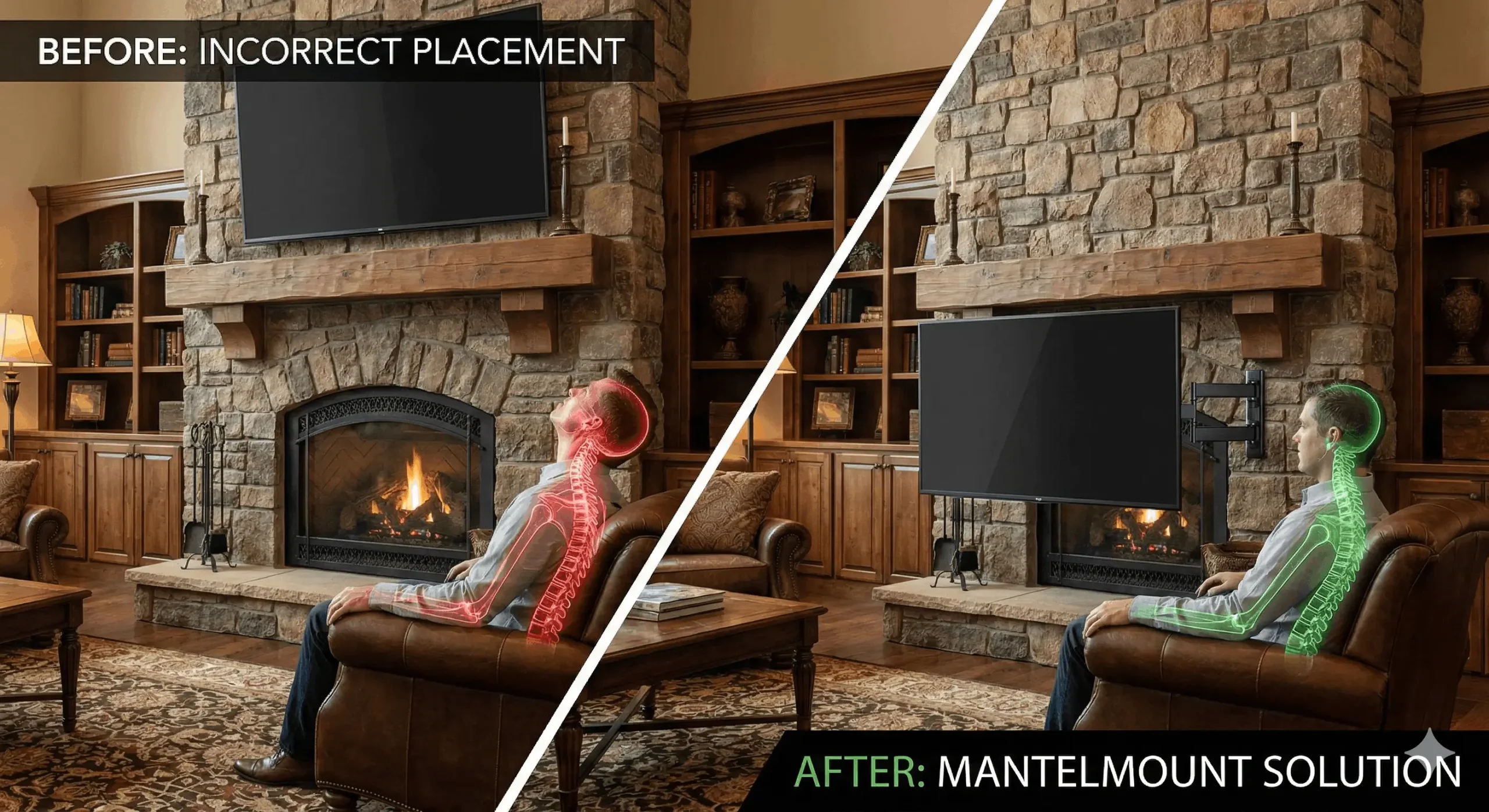
While this preserves the aesthetic symmetry of the room, it creates a functional nightmare. In most historic Kansas City homes, the mantel is nearly five feet off the ground. Mounting a 65-inch OLED screen above that height forces you to crane your neck to watch the Chiefs game.
As experts in both home entertainment and ergonomic design, we see the physical toll this takes on homeowners. It is not just uncomfortable; it is biomechanically unsound. Fortunately, there is a way to respect your home’s history without ruining your spine.
Mounting Your TV High Causes Chronic Cervical Spine Stress
To understand why a high-mounted TV is problematic, we have to look at human physiology. The human neck, or cervical spine, is designed to support the weight of the head in a neutral position. Your head weighs approximately 10 to 12 pounds. When your ears are aligned with your shoulders, this weight is distributed evenly.
However, the moment you tilt your chin up to look at a screen above the fireplace, the mechanics change. This is often referred to as “The Front Row Effect,” mimicking the discomfort of sitting in the front row of a movie theater.
The Physiological Impact:
- Cervical Extension: Tilting the head back places the cervical spine in extension. This compresses the facet joints in the back of your neck and shortens the suboccipital muscles at the base of your skull.
- Muscle Fatigue: To hold your head in this tilted position for a two-hour movie, your sternocleidomastoid and trapezius muscles must remain in a state of constant contraction. This leads to tension headaches and chronic stiffness.
- Eye Strain (Asthenopia): Our eyes naturally rest at a downward gaze of about 15 degrees. Forcing your eyes to rotate upward to view a screen causes the extraocular muscles to work harder, leading to dryness and fatigue.
For a comfortable, ergonomic viewing experience, the bottom third of your television screen should be at eye level when you are seated. In a standard sofa, your eye level is roughly 40 to 42 inches off the floor. A TV mounted above a fireplace is often sitting at 65 inches or higher. The math simply does not work for your body.
High Mounting Angles Degrade Picture Quality on Modern Screens
Beyond the physical discomfort, there is a technical penalty to mounting a TV too high. Despite the advancements in LED, QLED, and even OLED technology, all panels suffer from “off-axis” viewing degradation.
Liquid Crystal Displays (LCDs) are composed of layers. When you view them dead-on, the light passes through the pixels directly to your eyes. However, when you view the screen from below—looking up at a sharp angle—you are viewing the light path through the thickness of the glass and polarizing filters.
The Visual Consequences:
- Contrast Washout: Black levels appear grey or milky, destroying the dynamic range you paid for.
- Color Shift: Vivid reds and blues can shift in hue or lose saturation.
- Brightness Loss: The perceived brightness of the panel drops significantly as the vertical viewing angle increases.
You are effectively paying for a premium 4K experience but receiving a sub-par image because of the geometry of your living room.
The Pull-Down Mount Uses Hydraulics to Solve the Problem
The solution to this problem is not to remodel your living room, but to utilize smarter hardware. We advocate for the installation of Pull-Down TV Mounts (specifically the MantelMount series).
These are not standard static brackets. They are precision-engineered mechanical arms that utilize automotive-grade gas pistons and counterbalance springs. They allow a heavy 75-inch TV to sit flush against the wall when not in use, preserving the look of your historic room. When it is time to watch, you simply grab the handle (which is hidden behind the TV) and pull.
The gas pistons take the weight of the TV, allowing it to float effortlessly down and out, clearing the depth of your mantel. The TV stops in front of the fireplace, lowering the screen to perfect eye level.
| Feature | Standard Fixed Mount | Pull-Down Mount (MantelMount) |
|---|---|---|
| Viewing Angle | Fixed High (+15° upward tilt required) | Adjustable to Eye Level (Neutral neck position) |
| Cervical Strain | High (Risk of long-term pain) | Zero (Ergonomically correct) |
| Heat Safety | Constant exposure to rising heat | Includes heat-sensing handles that turn red if temps rise too high |
| Aesthetics | Permanent “Sports Bar” look | Hidden when passive, functional when active |
Installing Dynamic Loads on Historic Brick Requires Specialized Anchors
This is the part where most DIY enthusiasts—and even some general handymen—make a critical mistake. Installing a pull-down mount is significantly more complex than hanging a static picture frame, especially in a 100-year-old Kansas City home.
The Physics of Leverage:
A static mount holds the TV flat against the wall. The force is mostly “shear” (downward gravity). A pull-down mount, however, extends the TV nearly two feet away from the wall. This creates a massive cantilever effect. The leverage multiplies the force on the top bolts, trying to pull them straight out of the wall (tension load).
If you use standard plastic toggle bolts in a 1920s brick fireplace, the motion of pulling the TV down will eventually crumble the masonry, causing the mount to rip loose and crash onto your hearth.
SmartHome Connect Uses Preservationist Installation Techniques
At SmartHome Connect, we treat your chimney with the same respect as a structural engineer. We understand the composition of historic masonry. The brick in older homes is often softer, and the lime mortar can be sandy and brittle.
To ensure a safe installation that lasts for decades, we utilize a specific protocol for historic fireplaces:
- Brick vs. Mortar Drilling: We never drill into the mortar joints. Mortar is the weak link. We drill directly into the center of the brick, which offers superior holding power.
- Chemical and Sleeve Anchors: We do not use standard plastic plugs. We use specialized concrete sleeve anchors or chemical epoxy bonding agents that expand deep inside the brick to handle the dynamic tension load of the moving arm.
- Sound Testing: Before mounting, we test the integrity of the brick facade to ensure it is structural and not just a decorative veneer (which cannot support a TV).
We also understand the fear of “ruining” the fireplace. Our installation techniques are reversible. Should you ever sell the home and want to remove the TV, the holes can be filled with brick dust and color-matched mortar, leaving the history of the home intact.
You Can Have Modern Entertainment Without Sacrificing Comfort or History
You do not have to choose between a beautiful room and a comfortable movie night. The “TV over the fireplace” debate is solved not by compromise, but by engineering.
By using a counterbalanced pull-down mount, you respect the focal point of your historic home while respecting the biomechanics of your body. You get the clean, sophisticated look of the TV tucked away above the mantel when guests are over, and the immersive, theater-quality experience at eye level when it is time to relax.
Are you ready to stop craning your neck?
At SmartHome Connect, we have the tools to drill through century-old brick safely and the expertise to calibrate the perfect viewing angle for your living room. Let us help you bring your historic home into the high-definition era.